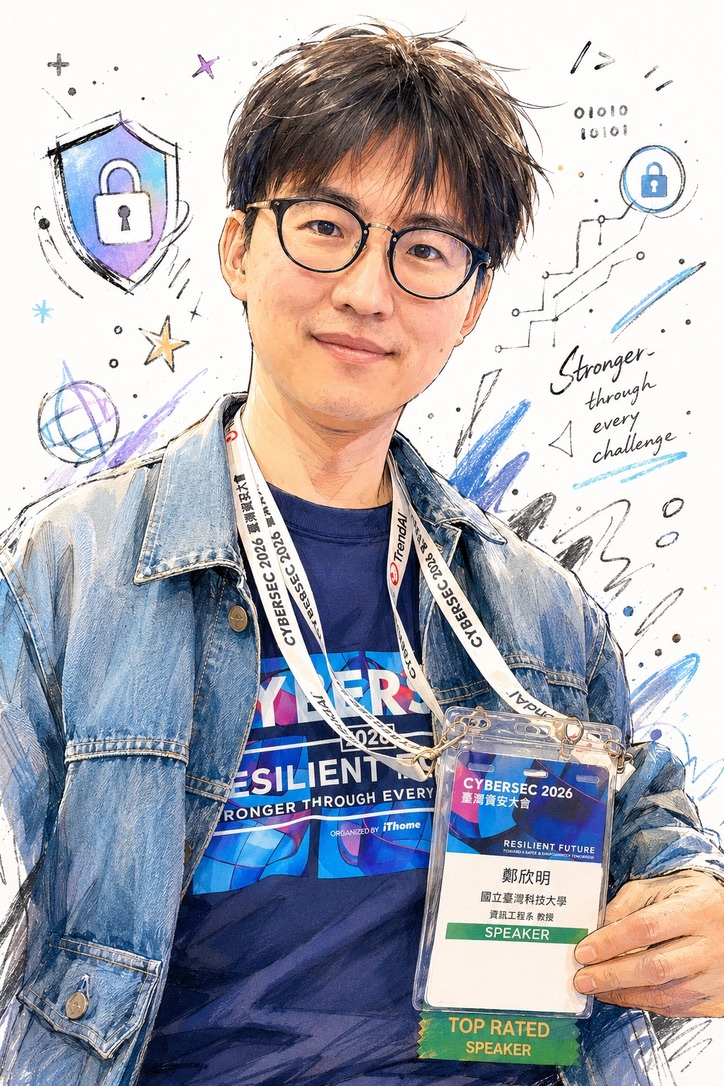
Short Bio
Shin-Ming Cheng received his B.S. and Ph.D. degrees in computer science and information engineering from National Taiwan University in 2000 and 2007, under the supervision of Prof. Phone Lin (Distinguished Professor, NTU CSIE). He then continued at NTU's Graduate Institute of Communication Engineering as a Post-Doctoral Research Fellow from 2007 to 2012, working with Prof. Kwang-Cheng Chen (now Professor at the University of South Florida).
He has been on the faculty of the Department of Computer Science and Information Engineering, NTUST since 2012, where he now serves as a full Professor. From 2022 to 2025 he served as Deputy Director-General — and briefly as Acting Director-General in early 2025 — at the Administration for Cyber Security (ACS) under Taiwan's Ministry of Digital Affairs. From 2017 to 2022 he was a Joint Appointment Research Fellow at the Research Center for Information Technology Innovation, Academia Sinica. Since 2025 he has served as a Professional Advisor — and as Senior Advisor from 2026 — to the National Institute of Cyber Security (NICS), and since 2022 as a Review Committee Member on the ISMS Certification Body Review Panel of the Taiwan Accreditation Foundation (TAF).
Since 2015 he has led the Advanced Information Security Summer School (AIS3) project, which has incubated more than 1,700 young security talents in Taiwan and produces the national team that competes at DEF CON CTF.
He maintains long-term joint research with the Cybersecurity Research Institute, NICT Japan and the Faculty of Information Technology, Brno University of Technology (BUT), Czech Republic, and runs the Connectivity Lab at NTUST.
鄭欣明 教授
鄭欣明教授為國立臺灣科技大學資訊工程系教授,2007 年取得國立臺灣大學資訊工程學系博士學位,由林風教授(國立臺灣大學資訊工程學系特聘教授)指導。2007 至 2012 年於國立臺灣大學電信工程學研究所擔任博士後研究員,與陳光禎教授(現任美國南佛羅里達大學教授)共同研究。
自 2012 年起任教於國立臺灣科技大學資訊工程系,現任專任教授。2022 至 2025 年借調至數位發展部資通安全署,擔任副署長,並於 2025 年 2 月短暫代理署長。2017 至 2022 年於中央研究院資訊科技創新研究中心兼任研究員。2025 年起擔任國家資通安全研究院顧問(2026 年起為資深顧問),並自 2022 年起擔任全國認證基金會(TAF)資訊安全管理系統驗證機構審議委員。
鄭欣明教授主要研究領域涵蓋 5G/6G 通訊安全(含 O-RAN 開放式無線接取網路、非地面網路 NTN)、物聯網 (IoT) 安全(韌體模擬、漏洞挖掘、端點偵測與回應)、人工智慧 (AI) 安全(對抗式機器學習、模型強健性評估),以及國家資安政策與戰略。
自 2015 年起主持資訊安全人才培育計畫 AIS3,至今已培育超過 1,700 名臺灣資安人才,並組成國家代表隊參加 DEF CON CTF 世界資安競賽。鄭欣明教授與日本國立情報通信研究機構 NICT 網路安全研究所與捷克布爾諾科技大學(BUT)資訊科技學院維持長期合作關係,於國立臺灣科技大學主持 Connectivity Lab 連結實驗室。
Four Areas of Work
5G / 6G Security
Security of next-generation wireless networks — Non-Terrestrial Networks, Open RAN, MEC, and 5G base-station vulnerabilities. 5+ CVEs disclosed in O-RAN reference stacks.
IoT Security
Vulnerability discovery in IoT systems — firmware emulation and dynamic analysis, fuzzing, multi-architecture binary analysis, endpoint detection & response (EDR), and IoT honeynets at scale.
AI Security
Adversarial & backdoor attacks on ML models, robustness evaluation of malware detectors, and AI-assisted threat analysis. Long-term joint research with the Cybersecurity Research Institute, NICT Japan.